Best Hydraulic Coupler Manufacturers in China

China’s hydraulic coupler manufacturers serve construction, agriculture, mining, and industrial machinery markets. Choosing a supplier takes more than comparing prices. A coupler must connect cleanly, seal under pressure, and tolerate repeated connection cycles. A leak at a dusty jobsite can stop an excavator as surely as a failed hose.

Industry reports offer useful context. MarketsandMarkets’ Hydraulic Fittings Market forecast tracks demand shaped by industrial activity and equipment production. Grand View Research’s hydraulic hose market analysis also points to the importance of dependable fluid-power components. These reports cover related markets, not couplers alone; their figures should not be treated as a direct measure of coupler demand. That distinction matters.

For technical perspective, Andrew Parr, author of Hydraulics and Pneumatics: A Technician’s and Engineer’s Guide, emphasizes sound component selection and maintenance. This is a paraphrase of the book’s practical guidance, not a direct quotation. ISO 16028 and ISO 7241 provide relevant reference points for flat-face and other quick-action couplings. Buyers should still verify the exact interface, working pressure, materials, test records, and compatibility with their equipment.

This guide compares Chinese manufacturers through those practical details, alongside production capabilities, quality documentation, and export support. A polished catalog is not proof of a reliable seal. Ask for test evidence. Check the threads yourself. Supplier claims deserve careful review, and even a strong factory may not fit every application.
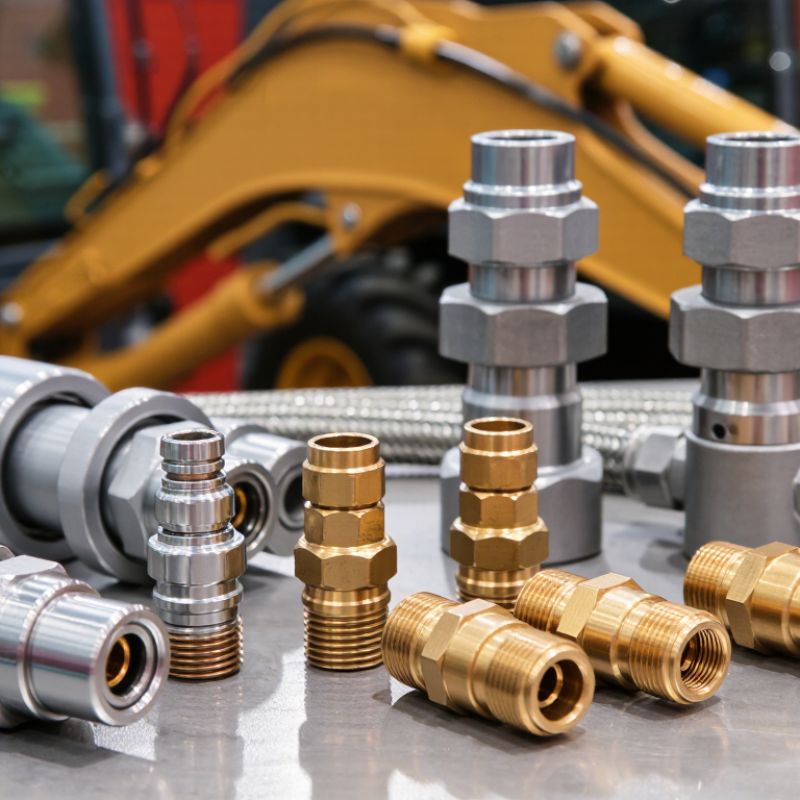
Best Hydraulic Coupler Manufacturers in China

Hydraulic Couplers: Main Types and the ISO 7241-1 Series

Hydraulic couplers connect and disconnect fluid lines, often while equipment is under pressure or exposed to dust and vibration. ISO 7241-1 covers dimensional and performance requirements for two common quick-coupling series: A and B. Their plug and socket profiles differ, so parts from one series should not be assumed to interchange with the other. The standard helps buyers compare connection dimensions and specified performance, but it does not replace checking the machine’s pressure, flow, and fluid requirements.

Series A and B are widely used in industrial hydraulic systems, including mobile machinery and factory equipment. Selection depends on the application, not just the thread size. Grand View Research estimated the global hydraulic equipment market at USD 42.2 billion in 2022 and forecast a 4.2% compound annual growth rate from 2023 to 2030. This broader market figure signals ongoing demand for hydraulic components, though it does not measure coupler sales alone. Small details matter. A coupler that fits may still restrict flow or fail under the system’s operating conditions.

Tips: Confirm the ISO series, working pressure, and flow rating before ordering. Check the standard’s specified dimensions, then verify the actual connection on the equipment. Keep dust caps on during storage. ISO conformity is useful, but it is not a substitute for application testing.

Best Hydraulic Coupler Manufacturers in China - Hydraulic Couplers: Main Types and the ISO 7241-1 Series

Coupler type or series Connection method Typical valve design Common applications and characteristics Standards context
ISO 7241-1 Series A Push-to-connect quick coupling; locking is commonly provided by balls or another mechanical locking arrangement. Typically poppet valves that close when disconnected. Used in hydraulic circuits where standardized interchangeability and a compact connection are required. Confirm size, pressure rating, and material for the specific product. One of the two quick-action coupling series covered by ISO 7241-1. Interchangeability depends on compliance with the relevant dimensional requirements.
ISO 7241-1 Series B Push-to-connect quick coupling with a mechanical locking arrangement. Typically poppet valves that close on separation. Common in industrial hydraulic and fluid-transfer systems. The appropriate model must be selected for the operating pressure, flow, fluid, and connection size. The other series specified by ISO 7241-1. Series A and Series B are distinct dimensional series and should not be assumed interchangeable with each other.
Flat-face quick coupling Connects by aligning the mating faces and engaging the locking mechanism; designs vary by product. Flat-face valves are designed to limit fluid loss and air inclusion during connection and disconnection. Often selected for mobile equipment and applications where reducing leakage and simplifying face cleaning are important. Flat-face hydraulic couplings are associated with ISO 16028, rather than the Series A/B dimensions of ISO 7241-1.
Screw-to-connect coupling The halves are joined by rotating a sleeve or nut to form the connection. Valve and sealing arrangements vary; some designs are intended to connect under specified residual-pressure conditions. Used where a threaded locking action is preferred, including certain demanding hydraulic applications. Follow the manufacturer’s connection and pressure instructions. Some screw-to-connect designs are covered by ISO 14541. This is a separate standard from ISO 7241-1.
Push-pull tractor coupling Connects by pushing the mating parts together; disconnection is designed to be practical at equipment connection points. Usually uses shut-off valves, with the exact configuration depending on the coupling design. Commonly used for agricultural and mobile machinery hydraulic lines, including applications where frequent implement changes are needed. “Push-pull” describes a connection style, not by itself an ISO 7241-1 series. Check the product documentation for its applicable dimensions and standard.

Selection note: ISO series designation alone does not establish a product’s pressure or flow capacity. Verify the coupling size, working pressure, allowable pressure during connection, fluid compatibility, temperature range, and mating-interface standard in the product documentation.


Key Technical Data: Working Pressure, Flow Rate, Leakage, and Cycle Life

Best Hydraulic Coupler Manufacturers in China

When comparing hydraulic coupler manufacturers in China, request technical data for the exact coupler size and seal material. Working pressure should reflect continuous operation, not just a short burst rating. Check whether the stated value applies to both connected halves and whether pressure spikes were considered. A machine that runs at 25 MPa may need a coupler rated above that level, depending on its operating conditions. Details matter.

Flow rate affects pressure loss and heat. Ask for the test flow, fluid viscosity, and pressure-drop curve; a bare maximum-flow figure tells little. Leakage data should distinguish external leakage from fluid loss during connection and disconnection.

For cycle life, request the test pressure, connection frequency, and inspection criteria. A coupler tested under clean, controlled conditions may wear faster in dusty field work. I would not treat one cycle count as a guarantee.

Tips: Match the test conditions to your machine. Ask for dated test reports, material specifications, and batch traceability. If the supplier cannot explain how leakage was measured, pause and verify. It is easy to overlook fluid temperature, but it can change seal performance.

China’s Leading Manufacturers: Product Portfolios and Application Sectors

Best Hydraulic Coupler Manufacturers in China
China’s Leading Manufacturers: Product Portfolios and Application Sectors

Chinese manufacturers offer couplers for excavators, agricultural machinery, forestry equipment, and industrial hydraulic systems. Common portfolios include flat-face, screw-to-connect, push-to-connect, and multi-coupler designs. These serve different needs: clean connection changes, vibration resistance, fast tool swaps, or several hydraulic lines connected together. Material choice, seal design, pressure rating, and interchangeability vary by model, so product names alone are not enough for comparison.

The China Construction Machinery Association reported 195,018 excavator sales in 2023, including domestic and export sales. This figure signals a substantial equipment market where reliable hydraulic connections matter. Coupler suppliers also serve tractors, loaders, and mobile machinery, where dust, mud, and repeated connection cycles can quickly expose weak seals. A catalog may look complete, yet field compatibility is where specifications get tested. That detail is easy to underestimate.

Tips: Match the coupler to working pressure, flow, fluid, and connection standard. Ask for test records and confirm compatibility with the machine’s existing fittings before ordering.

Quality Benchmarks: ISO 16028, ISO 7241-2, and Test Reports

Best Hydraulic Coupler Manufacturers in China

Quality Benchmarks: ISO 16028, ISO 7241-2, and Test Reports

When comparing hydraulic coupler manufacturers, check which standard applies to the coupling design. ISO 16028 covers flat-face couplings, while ISO 7241-2 describes test methods for applicable quick-action couplings. A standard reference alone does not prove that every product size or configuration was tested. Ask for documentation matching the exact model, size, and materials you plan to buy. Details matter.

A useful test report identifies the test method, pressure conditions, cycle count, leakage results, and test date. It should also make clear whether the sample represents routine production or a one-off prototype. Check that conclusions are specific and traceable, not just a general statement of compliance. A neat report can still leave gaps; asking for clarification is sensible. For production checks, compare report records with inspection documents and product markings.

Tips: Request the full report, not only a certificate. Confirm the standard edition and tested configuration. If the intended operating pressure or fluid differs from the test conditions, ask what additional verification is needed.

Comparing Suppliers by Specifications, Certifications, and Export Records

Best Hydraulic Coupler Manufacturers in China
Comparing Suppliers by Specifications, Certifications, and Export Records

A reliable comparison starts with the exact coupler model, not a supplier’s broad catalog. Check working pressure, flow capacity, body material, seal compound, connection dimensions, and operating temperature. ISO 7241 covers hydraulic quick-action couplings; ISO 16028 specifies flat-face coupling requirements. Ask for model-specific test reports covering leakage and pressure cycling. Small details matter. A certificate alone does not prove that every product line has been tested.

Export records need similar scrutiny. Request recent shipment references, destination markets, delivery performance, and records of product claims. The World Bank’s 2023 Logistics Performance Index gave China a score of 3.7 out of 5. This reflects national logistics performance, not any manufacturer’s reliability, so treat it as context rather than proof. Compare that indicator with factory-level evidence, such as inspection records and traceable batch documents. I would also ask how the supplier handles a failed sample; responses can be less polished than brochures, but more revealing.

Best Hydraulic Coupler Manufacturers in China - Comparing Suppliers by Specifications, Certifications, and Export Records

ISO 7241:2014 is organized into two parts: Part 1 covers dimensions, and Part 2 covers test methods. The chart shows one standard part for each topic—not supplier scores.

Use these standard topics as a starting point when comparing suppliers. Verify each supplier’s product specifications, current certificates, and export documentation directly; this chart does not represent company-specific data.

Get a Quote
910-483-7828