China Top Double Eccentric Butterfly Valve Supplier?
Choosing a China Top Double Eccentric butterfly valve Supplier requires more than comparing prices. It requires evidence from demanding service conditions.
The global industrial valve market continues expanding across water, energy, chemical, and process industries. Grand View Research reported a global industrial valves market value of approximately USD 78 billion in 2023, with continued growth expected through 2030. Mordor Intelligence also identifies infrastructure investment and water treatment as important market drivers. These figures show opportunity, but they do not prove supplier quality.
A Double Eccentic butterfly valve should be judged through measurable details. Examine body materials, shaft design, seat compounds, pressure ratings, and test procedures. Ask for ISO 9001 certification, EN 10204 material certificates, pressure-test records, and traceable serial numbers. A reliable factory should explain how its valve performs after thousands of cycles, not only display polished photographs. George A. Antaki, author of Valve Handbook, states, “Valve selection is a system decision, not a component decision.” That principle remains practical. A valve can look excellent and still fail through incorrect sizing, abrasive media, or poor actuator matching.
Site experience matters too. Listen for leakage data, delivery consistency, coating thickness, and field references. No supplier is flawless. That assumption needs testing. Buyers should compare drawings, inspection plans, warranty terms, and response times before naming China’s top supplier. The strongest candidate combines engineering discipline with honest limitations. Sometimes, the quiet factory with detailed documents deserves more confidence than the loudest exporter.
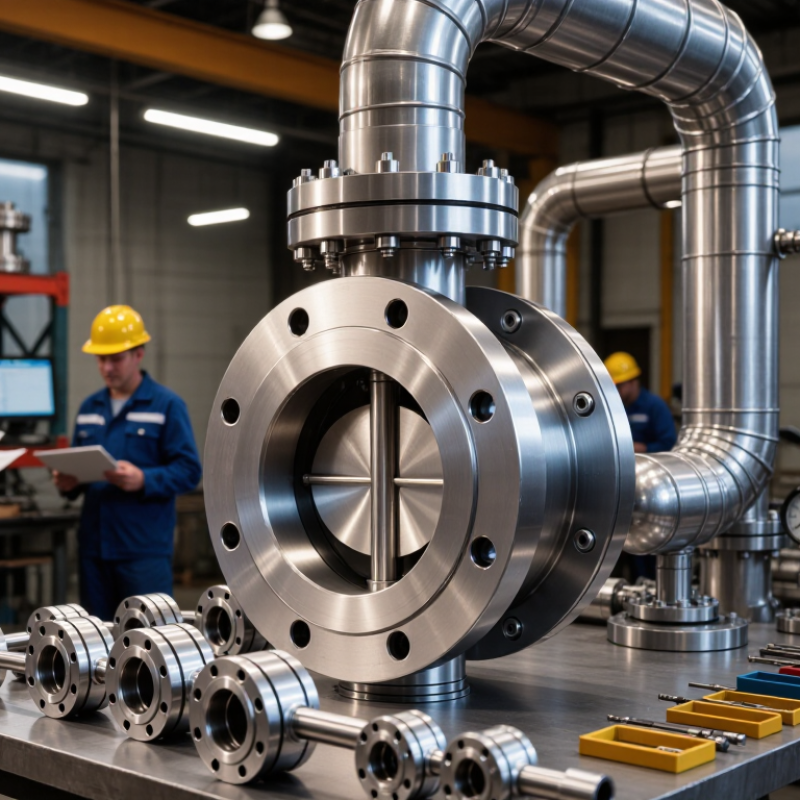
What Is a Double Eccentric Butterfly Valve?
A double eccentric butterfly valve has two deliberate shaft offsets. The stem sits away from the pipe centerline and the disc sealing axis. This geometry lets the disc move away from the seat soon after opening. Friction decreases. Seat damage can decrease too. The valve still uses a quarter-turn movement, making it practical for water, cooling systems, power facilities, and industrial pipelines.
It is not simply a larger butterfly valve. Its performance depends on seat material, disc finish, shaft design, pressure rating, and installation quality. ISO 5752 provides face-to-face dimensions for many industrial valves, while API 609 covers butterfly valve design and testing practices. These standards support consistent engineering checks, but they do not guarantee suitable service selection. Pressure, temperature, fluid chemistry, and flow direction must be reviewed together.
Market data also shows why this design remains relevant. Grand View Research estimated the global industrial valves market at approximately 78.8 billion US dollars in 2023, with continued growth expected through 2030. That figure covers many valve types, not only butterfly valves. Still, it reflects sustained investment in pipeline control equipment. In practical inspections, I would check the seat after repeated cycling, not trust catalog torque alone. A minor alignment error can create serious leakage. This point is often overlooked. Reliable suppliers should provide material certificates, pressure-test records, dimensional drawings, and traceable inspection results before shipment.
How Does a Double Eccentric Butterfly Valve Work?
How Does a Double Eccentric Butterfly Valve Work?
A double eccentric butterfly valve uses a disc mounted away from the pipe centerline. The shaft is offset from the disc center and the sealing centerline. This geometry reduces rubbing between the disc and seat during operation. When the handle or actuator turns the shaft, the disc rotates through the pipeline. Near the closed position, the disc moves into the seat and creates a tight seal. During opening, it quickly moves away from the seat, reducing wear and operating torque.
In field inspections, this design performs well in water, air, and many industrial fluid systems. Its reduced friction can extend seat life compared with a concentric design. However, performance depends on correct sizing, pressure control, and material selection. The valve is not magic. Poor alignment, abrasive media, or incorrect installation can still cause leakage. Operators should check the flow direction, flange alignment, and actuator output before commissioning.
Tips: Choose the seat material according to temperature and medium compatibility. Keep the pipeline clean before installation. A small amount of debris can damage the sealing surface. Test the valve slowly, and watch for unusual vibration or resistance. A supplier with documented pressure testing and traceable inspection records offers greater reliability.
Key Features of China’s Leading Valve Suppliers
China Top Double Eccentric Butterfly Valve Supplier?
A leading Chinese valve supplier combines practical engineering with controlled manufacturing. Double eccentric designs reduce disc-to-seat contact during opening. This lowers friction, wear, and operating torque in large pipelines. Strong suppliers select ductile iron, carbon steel, or stainless steel for specific media and temperatures.
According to Grand View Research, the global industrial valves market was valued at about USD 78.4 billion in 2023. Its analysis projects continued growth through 2030. This demand increases pressure on suppliers to provide stable quality, not only competitive pricing.
Reliable manufacturers use CNC machining, dimensional inspection, pressure testing, and traceable material certificates. Documents matter. Testing should follow recognized requirements, such as API 598, API 609, or EN 593, where applicable.
Export capability is another key feature. Experienced suppliers understand flange standards, actuator sizing, coating thickness, packaging, and site conditions.
MarketsandMarkets identifies energy, water, and process industries as major valve demand sectors, making application knowledge especially valuable.
A capable supplier should explain seat materials, leakage class, pressure ratings, and maintenance intervals in clear language.
No supplier is flawless. Some catalogs hide important limitations, including temperature restrictions or unsuitable media. Buyers should request test records and inspect production samples when possible.
A factory visit can reveal more than polished photographs. Supplier selection becomes stronger when engineering evidence supports every promise.
How to Evaluate a Chinese Double Eccentric Valve Manufacturer
Evaluating a Chinese double eccentric butterfly valve manufacturer requires more than comparing quotations. A reliable assessment begins with application details: medium, pressure class, temperature, pipe size, and operating cycles. Ask for drawings, material certificates, and test procedures. Serious manufacturers explain how the disc shifts away from the seat during opening. This reduces rubbing and supports longer service life. Short claims are not enough.
During a factory review, inspect machining, assembly, and pressure-testing areas. Ask how shafts, discs, bodies, and seats remain traceable after production. Request quality certificates and confirm their scope. A video audit can help, but it cannot replace physical verification. Check whether inspectors use calibrated equipment. Small details matter.
Request body and seat pressure-test records, dimensional reports, coating data, and a sample inspection plan. Compare stated standards with actual documents, not website language. Review failure handling, spare parts, and response times. A dependable supplier gives clear tolerances and admits design limits. I would also ask for references from similar water, HVAC, or industrial projects. One weakness matters: some suppliers present polished documents but give vague answers about cycle testing. Treat that gap seriously. A lower price may hide thinner components, weaker inspection, or uncertain sealing performance. My first impression can be wrong, so I prefer evidence gathered from drawings, test records, and direct technical questions.
Applications, Standards, and Quality Inspection Criteria
China Top Double Eccentric Butterfly Valve Supplier?
A capable supplier should explain where double eccentric butterfly valves fit, not only quote low prices. Their offset disc reduces rubbing during opening and closing. This suits cooling-water lines, municipal water networks, HVAC systems, and selected process services. They are not universal. Abrasive slurry, severe cavitation, or incompatible chemicals may require another valve design. Field experience shows that media, temperature, pressure, and actuator torque must be reviewed together.
Standards provide a useful control framework. API 609 and EN 593 are common references for butterfly valve design and testing. ISO 5211 can guide actuator mounting dimensions, while ISO 5208 supports leakage testing classification. The purchaser should confirm the required edition and service class. A standard name alone proves little. Drawings, material certificates, welding procedures where applicable, and full traceability matter more during a real audit.
Quality inspection should cover body and disc materials, face-to-face dimensions, flange drilling, coating thickness, and stem alignment. Inspectors should witness shell and seat pressure tests with calibrated gauges. Record test pressure, duration, medium, and observed leakage. Measure operating torque at several positions, not only fully open and closed. Check packing, fasteners, and actuator travel. A small scratch under the coating can become a serious corrosion point. No inspection plan is flawless. I have seen paperwork pass while a valve failed on site because installation strain was ignored. Supplier evaluation should therefore include sample testing, corrective-action records, and practical installation support.