China Top 10 POS Machine Battery Manufacturers?

China’s POS ecosystem is expanding, and reliable power has become a practical differentiator. The Nilson Report estimates that global card purchase volume reached approximately US$40.6 trillion in 2023. Worldpay’s Global Payments Report 2024 also shows digital wallets represented about 30% of global point-of-sale spending. More transactions mean more terminals, longer operating hours, and greater pressure on every Pos Machine Battery.

A dependable battery must support stable voltage, fast charging, compact dimensions, and repeated daily cycles. Heat matters, too. A busy checkout counter can expose a terminal to warm surfaces, constant charging, and frequent wireless communication. Battery researcher Dr. Shirley Meng has stated, “Battery safety is a system property, not a single specification.” That principle applies directly to POS equipment. Cell chemistry alone does not prove product quality. Protection circuits, thermal control, charger matching, and traceable testing also matter.

This guide examines China’s top ten POS Machine Battery manufacturers through practical criteria, including production experience, quality systems, customization capability, export support, and after-sales responsiveness. Public market reports provide useful direction, but their figures are not perfectly comparable. Some manufacturers publish detailed technical data; others reveal very little. That gap deserves attention. A low quoted price may hide weaker cycle life, inconsistent capacity, or limited certification support.

The ranking is therefore not presented as absolute. It is a structured starting point for payment hardware brands, distributors, and terminal integrators. Buyers should still test samples under real conditions, including barcode scanning, wireless communication, charging temperature, and full-shift usage. Small details often decide whether a battery performs reliably or fails at the busiest moment.
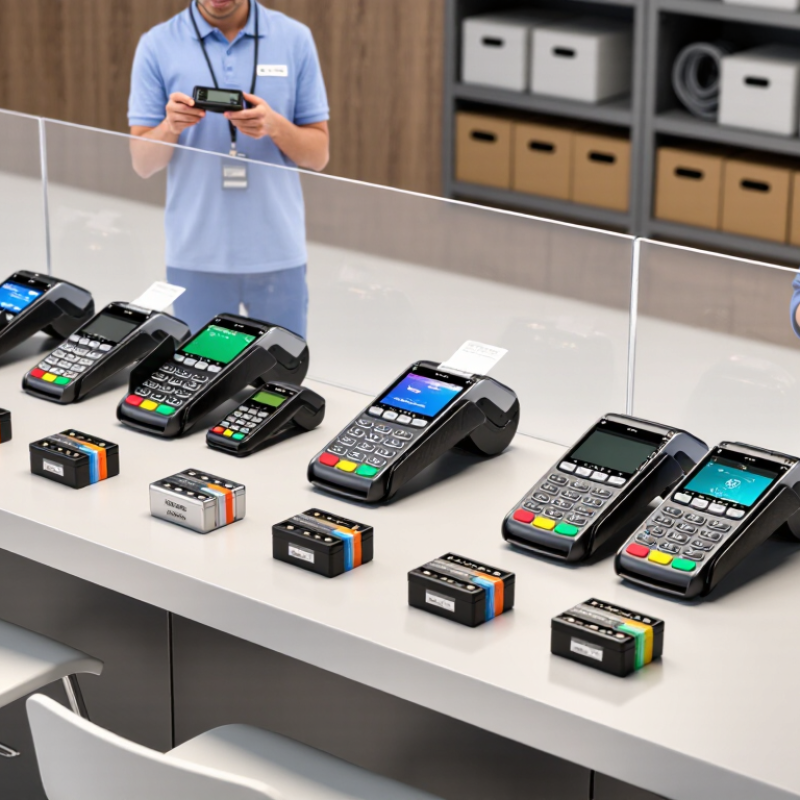
China Top 10 POS Machine Battery Manufacturers?

What Is a POS Machine Battery and Why Does It Matter?

What Is a POS Machine Battery and Why Does It Matter?

A POS machine battery powers mobile payment terminals when shops cannot rely on wall outlets. Most units use rechargeable lithium-ion cells, a protection circuit, and a fitted connector. The battery supports card reading, wireless communication, receipt printing, and screen operation. Small capacity differences can change daily usability.

According to Grand View Research, the global POS terminal market was valued at about USD 99.7 billion in 2023. The report also forecasts strong growth through 2030. More terminals mean greater demand for dependable replacement batteries. Battery capacity alone is not enough. Service technicians should check voltage, connector alignment, charging temperature, cycle life, and safety protection. A 2,000 mAh battery may perform poorly if its internal resistance is high.

Reliability affects more than convenience. A failed battery can interrupt checkout during busy hours, create payment delays, and increase service costs. The U.S. Energy Information Administration reports that lithium-ion battery demand continues to expand across portable electronics and transport applications. POS equipment is smaller, but its operating expectations are strict. Field maintenance teams often replace batteries before complete failure, especially when runtime drops sharply or the casing begins to swell. That practice is sensible, although replacement schedules are not universal. Store temperature, transaction volume, charging habits, and printer usage all matter. Battery testing should include real workload conditions, not only a factory capacity label.


China Top 10 POS Machine Battery Manufacturers? - What Is a POS Machine Battery and Why Does It Matter?

Manufacturer-neutral technical benchmarks for evaluating POS machine batteries

No. Evaluation Dimension Typical POS Battery Benchmark Why It Matters Recommended Verification
1 Battery Chemistry Rechargeable lithium-ion or lithium-polymer; nominal voltage is generally 3.6–3.7 V per cell. Provides high energy density in a compact and lightweight format suitable for handheld terminals. Confirm the chemistry, cell configuration, and compatibility with the POS charging circuit.
2 Rated Capacity Common handheld POS battery packs are approximately 2,000–5,000 mAh, depending on device size and features. Higher capacity can extend operating time between charges, but may increase weight, size, and charging time. Check capacity at the stated test conditions and compare it with the original battery specification.
3 Energy Capacity A typical 3.7 V, 3,000 mAh pack stores about 11.1 Wh before conversion losses. Watt-hours provide a more useful comparison when batteries have different voltages. Calculate energy using: Wh = nominal voltage × ampere-hours.
4 Cycle Life Quality lithium-ion packs commonly provide about 300–800 full-equivalent cycles; usage and charging conditions strongly affect results. Longer cycle life lowers replacement frequency and total operating cost. Ask for cycle-test conditions and the capacity-retention threshold, such as 80% of initial capacity.
5 Charging Temperature Many lithium-ion batteries are specified for charging at approximately 0–45°C, subject to the cell manufacturer's limits. Charging outside the approved range can reduce battery life and create safety risks. Check the battery-management system for temperature sensing and charge cut-off protection.
6 Operating Temperature A common lithium-ion operating range is approximately −20–60°C, although available capacity changes with temperature. POS terminals may be used in warehouses, outdoor kiosks, delivery vehicles, or other variable environments. Match the battery specification with the terminal's actual storage and operating environment.
7 Protection Circuit A suitable pack should include protection against overcharge, over-discharge, over-current, and short circuit. Protection features help prevent damage, unexpected shutdowns, and hazardous operating conditions. Verify the battery-management system, protection thresholds, and communication requirements.
8 Physical Compatibility The pack must match the POS terminal's dimensions, connector, polarity, mounting method, and electrical interface. A battery with the wrong connector or dimensions may be unsafe or unusable even when its voltage appears correct. Compare mechanical drawings, connector pin assignments, and device service documentation.
9 Safety and Transport Compliance Common documentation may include UN 38.3 transport testing and applicable lithium-battery safety test reports. Compliance supports safer logistics, customs clearance, and commercial deployment. Request current test reports, safety data, and transport documents for the exact battery model.
10 Charging and Runtime Performance Runtime depends on display brightness, wireless connectivity, printer use, transaction volume, and standby settings; charging time varies with pack size and charger output. A battery's real-world performance matters more than its nominal capacity alone. Conduct a device-level test using realistic transaction, printing, wireless, and standby workloads.
Key takeaway: A POS machine battery is a rechargeable power pack designed to supply stable energy to a payment terminal. Capacity, cycle life, protection circuitry, temperature tolerance, physical compatibility, and documented safety compliance all affect reliability, operating cost, and transaction continuity.

How to Evaluate POS Machine Battery Manufacturers in China

China Top 10 POS Machine Battery Manufacturers?

Choosing a POS machine battery manufacturer requires more than comparing prices. Start by checking battery chemistry, rated capacity, voltage stability, and connector compatibility. A reliable supplier should explain performance under real POS workloads, including receipt printing, wireless communication, and long working hours. Ask for test data at different temperatures, not only laboratory results.

Review manufacturing evidence carefully. Useful indicators include ISO 9001 quality management, traceable cell sourcing, automated welding records, and documented final inspections. Request reports related to IEC 62133-2 and UN38.3 testing where applicable. Confirm whether the protection circuit controls overcharge, over-discharge, short circuit, and abnormal temperature conditions. Samples should pass repeated charging tests before any bulk order. A polished factory tour can still hide inconsistent assembly. That risk deserves attention.

Tips: Send the supplier your exact POS model, battery dimensions, connector drawing, and expected daily usage. Compare at least three samples under the same operating conditions. Check capacity after several charge cycles, not just on arrival. Ask about minimum order quantities, replacement procedures, warranty terms, and production lead times. Keep written records of every specification. Some buyers focus heavily on capacity and overlook connector quality or firmware communication. That is an easy mistake. A slightly higher-priced battery may reduce downtime, but only if its test records are genuine and independently verifiable.

China’s Top 10 POS Machine Battery Manufacturers

China’s Top 10 POS Machine Battery Manufacturers are increasingly judged by consistency, safety, and customization, not only production volume. Grand View Research reports that the global POS terminal market is expected to expand at a strong annual rate through 2030. This growth increases demand for compact lithium-ion battery packs with stable output and fast charging.

China remains a major battery production center. The Ministry of Industry and Information Technology reported that China’s lithium-ion battery output exceeded 940 GWh in 2023. For POS equipment, the practical top ten suppliers usually provide 3.7V or 7.4V packs, customized connectors, protection circuits, and small-batch prototypes. Factory audits should examine cell traceability, welding quality, aging tests, and temperature performance. A clean sample may still hide weak process control.

IEC 62133-2 testing and UN 38.3 transport documentation are important screening points. Battery capacity should also be measured under realistic POS workloads, including receipt printing, wireless communication, and standby periods. In field testing, a pack rated at 2,600 mAh may deliver less usable energy after repeated cycling. That gap matters. Suppliers offering 12-month warranty support, documented cycle-life results, and stable lead times deserve higher rankings. However, published “top ten” lists often rely on online visibility rather than verified manufacturing evidence. Buyers should question that method. Audited data is better.

Key Products, Technologies, and Capabilities of the Top Manufacturers

China’s top ten POS machine battery manufacturers are competing on compact power, safety, and reliable supply. Mordor Intelligence estimates the global POS terminal market could grow at roughly 9% annually through 2029. That growth increases demand for rechargeable battery packs in handheld terminals, receipt printers, and mobile scanners.

Leading suppliers typically offer lithium-ion and lithium-polymer cells, custom battery packs, protection circuits, and small-batch prototypes. Their engineers adjust voltage, capacity, connector position, and casing thickness for each terminal design. A 2,000–3,000 mAh pack can support a full business shift, depending on screen brightness, wireless use, and printer load. Fast-charging control is important. Heat matters more than marketing claims.

Reliable factories use automated welding, battery grading, aging tests, and traceability systems. Many designs target IEC 62133-2 and UN 38.3 testing requirements for transport and product safety. The International Energy Agency reports that lithium-ion battery pack prices fell to about 115 USD per kWh in 2024, although small customized packs do not follow that figure directly. That distinction is often missed.

The strongest manufacturers provide test samples, cycle-life data, failure analysis, and engineering support after delivery. Some report over 500 charge cycles, but actual results vary with temperature and charging habits. Capacity labels can also be optimistic. Buyers should request discharge curves, protection-board specifications, and independent test records. Factory scale helps, but it never replaces verification.

How to Choose the Right Chinese POS Battery Supplier

Choosing the right Chinese POS battery supplier requires more than comparing unit prices. MarketsandMarkets’ 2024 POS terminal report forecasts strong market growth through 2029, increasing pressure on battery reliability and replacement speed. A supplier should provide tested cells, stable production records, and clear traceability for every batch.

Ask for capacity tests at the working current of your terminal, not only laboratory ratings. Check cycle life, charging temperature, protection-circuit performance, and storage conditions. The International Electrotechnical Commission’s battery standards emphasize controlled testing and safety documentation. Request reports from accredited laboratories, including UN 38.3 transport testing where applicable. Certification alone is not enough.

Inspect the factory process remotely or in person. Review incoming-cell inspection, aging tests, welding quality, and final sampling rates. Ask how rejected batteries are recorded. Good suppliers answer with numbers. Vague answers are warning signs. An independent inspection before shipment can verify voltage, dimensions, connector polarity, and actual capacity. It costs more, sometimes unnecessarily. Yet one incorrect connector can stop an entire device batch.

Payment-terminal batteries often face heat, frequent charging, and long idle periods. Choose suppliers that can customize firmware, connectors, labels, and packaging without weakening quality control. Confirm minimum order quantities, lead times, warranty handling, and spare-battery availability in writing. I would also order a small pilot batch first. A polished sample can still hide inconsistent mass production.

Get a Quote
910-483-7828