2026 Top Solar Energy Light Pole Types?

The 2026 Top Solar Energy Light Pole Types? This topic deserves more than a product list. It should explain how each solar energy light pole performs under real conditions, including weak winter sunlight, coastal wind, dust, and nighttime traffic.

Nobel laureate and former U.S. Energy Secretary Steven Chu once described the sun as “the only safe nuclear reactor, situated 93 million miles away.” His observation highlights the enormous energy source behind solar lighting, but practical design remains difficult. A pole still needs the right photovoltaic panel, battery capacity, LED output, controller, and mounting height. One attractive model may fail beside a shaded road. Another may overlight a quiet pathway and waste stored energy.

This outline will compare integrated, split-type, smart, hybrid, and high-mast solar energy light pole designs. It will examine their operating structures, installation needs, maintenance demands, and performance in different climates. Field experience matters here. Engineers should review shadow maps, local solar radiation, drainage, wind exposure, and pedestrian movement before selecting equipment. A bright sample installed in a showroom proves very little.

No design is perfect. That matters.

Battery aging can reduce autonomy after several cloudy nights. Sensor settings may also create dark spots or unnecessary lighting cycles. Reliable recommendations should therefore include test data, realistic warranty terms, verified safety certifications, and transparent replacement costs. The strongest 2026 options may not be the brightest or cheapest. They may be the poles that deliver steady illumination, simple servicing, and measurable value over many years.
2026 Top Solar Energy Light Pole Types?

Solar Energy Light Poles: Definition and Core Components

2026 Top Solar Energy Light Pole Types?

Solar Energy Light Poles: Definition and Core Components

Solar energy light poles are outdoor lighting systems that generate, store, and use electricity independently. They combine a photovoltaic panel, rechargeable battery, LED fixture, controller, pole, and mounting hardware. In practical installations, these parts must work as one system. A strong panel cannot compensate for a weak battery or poor drainage.

Common types include all-in-one poles, split-panel poles, and hybrid solar poles. All-in-one models place the panel, battery, and light near the fixture. They simplify installation and suit pathways or small parking areas. Split-panel designs separate the panel from the lamp. This arrangement allows better panel orientation and often supports higher lighting output. Hybrid systems can use solar power with grid assistance, but their wiring requires qualified inspection.

Battery capacity affects nighttime performance most directly. Lithium-based batteries usually provide efficient storage and longer cycle life. The controller manages charging, dimming, and low-voltage protection. A motion sensor can reduce brightness when no one is nearby. This saves energy, though sensor settings may feel uncomfortable in busy public spaces.

Pole height, wind loading, soil conditions, and local solar exposure need engineering review. A shaded panel can reduce winter performance sharply. Dust also matters. During site checks, I would record shadow movement, not only midday sunlight. Specifications are never perfect; real weather, vandalism risk, and maintenance access can change the result. Loose fasteners and blocked panels remain common field problems.


How Solar Light Poles Work from Sunlight to Nighttime Illumination

2026 Top Solar Energy Light Pole Types?

How Solar Light Poles Work from Sunlight to Nighttime Illumination

A solar light pole converts sunlight into stored electrical energy each day. Photovoltaic modules generate direct current when photons reach their silicon cells. A charge controller then regulates energy entering the battery. This protects the battery from overcharging and excessive discharge. At night, a photocell or programmed controller activates the LED fixture. Stored electricity flows through the driver, producing steady roadway or pathway illumination. The process is quiet, automatic, and easy to observe.

Pole designs usually include all-in-one, split-panel, and hybrid configurations. All-in-one units place the panel, battery, controller, and lamp inside one compact head. Split systems separate the panel from the fixture, allowing better solar orientation. This matters in shaded streets or narrow urban corridors. IRENA’s Renewable Capacity Statistics 2024 reported global solar capacity exceeding 1,400 GW at the end of 2023. Solar supply is expanding rapidly, but sunlight remains highly site-specific.

Battery sizing demands practical judgment. A bright summer day cannot represent winter performance. Designers review solar irradiation, autonomy days, operating temperature, and nighttime traffic patterns. Lithium-based batteries often provide useful energy density, yet cold conditions can reduce available capacity. The Global Off-Grid Lighting Association has repeatedly identified affordability, durability, and after-sales support as key market concerns. A technically impressive pole may still underperform if its panel faces seasonal shade, its battery is undersized, or maintenance access is ignored. Field testing should include several cloudy nights. Forecasts are never perfect.

2026 Top Solar Energy Light Pole Types: From Sunlight to Nighttime Illumination

The chart shows representative engineering ranges for overnight battery autonomy by common solar light pole design. During the day, photovoltaic panels convert sunlight into electricity, a charge controller stores the energy in the battery, and the LED luminaire uses that stored energy after sunset. Actual performance depends on solar irradiation, panel orientation, battery capacity, lighting power, weather, and programmed dimming.

Main Types of Solar Energy Light Poles in 2026

Main Types of Solar Energy Light Poles in 2026

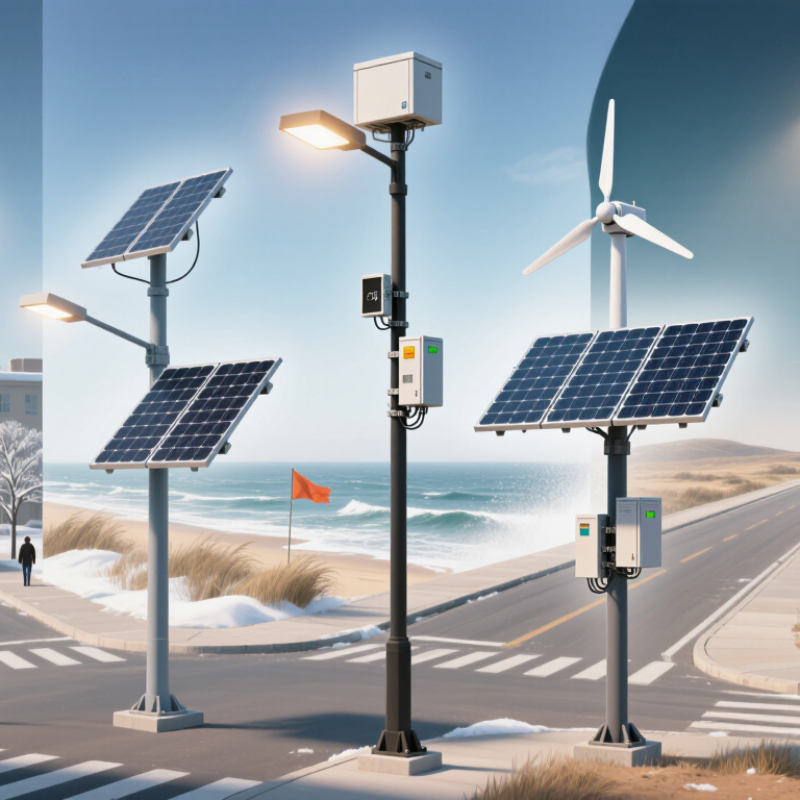
Solar energy light poles are developing into several practical types. The all-in-one pole places the panel, LED lamp, battery, and controller inside one compact head. It suits pathways, parking areas, and small streets where installation speed matters. Split-type poles separate the panel from the light fixture. This design allows larger panels, flexible panel angles, and easier battery maintenance. It often performs better in shaded or cloudy locations.

Vertical-panel poles use upright photovoltaic modules around the structure. They collect sunlight from different directions and resist some wind pressure. However, their output may be lower than angled panels in certain regions. Hybrid solar poles combine solar power with grid support. They can maintain lighting during extended cloudy periods, but their wiring and control systems require more planning. Smart poles may add motion sensors, remote monitoring, or adaptive dimming. These features reduce energy use, yet they also introduce more components that can fail.

Tips: Match the pole type with local sunlight, shadow patterns, wind conditions, and required lighting levels. Check battery autonomy for several cloudy nights, not only one clear day. Confirm IP and impact protection ratings before installation. Field inspections should also review panel dust, battery temperature, and cable aging. No design is perfect. A lower-cost system may become expensive when maintenance access is ignored. Photometric calculations and an on-site trial can reveal problems that drawings miss.

2026 Top Solar Energy Light Pole Types? - Main Types of Solar Energy Light Poles in 2026

Comparison of the main solar energy light pole configurations, typical specifications, and recommended applications.

Solar Light Pole Type Typical Pole Height Typical LED Power Solar Panel Configuration Battery Technology Best-Fit Applications Main Advantages Key Considerations
All-in-One Solar Street Light Pole 5–12 m 20–150 W Integrated panel, LED module, controller, and battery in one compact luminaire Lithium iron phosphate or other lithium-ion batteries Urban streets, residential roads, parking areas, and walkways Simple installation, clean appearance, reduced wiring, and relatively low maintenance Limited component spacing and possible heat buildup in compact housings
Split-Type Solar Street Light Pole 6–14 m 30–200 W Separate photovoltaic panel, luminaire, controller, and battery enclosure Lithium-ion or sealed lead-acid, depending on design and budget Main roads, larger streets, high-demand public areas, and sites needing flexible sizing Better component ventilation, easier service access, and greater design flexibility More installation work, additional cable routing, and a larger visual footprint
Vertical Solar Panel Light Pole 4–10 m 15–100 W Long, narrow panels mounted vertically or along the pole structure Lithium iron phosphate is commonly selected for compact systems Narrow roads, coastal locations, windy areas, and sites with limited horizontal space Smaller wind-facing area, reduced dust accumulation, and efficient use of narrow sites Energy yield depends strongly on orientation, latitude, shading, and panel design
Adjustable-Panel Solar Light Pole 5–12 m 20–150 W Tilt- or angle-adjustable photovoltaic panel Lithium-ion or sealed lead-acid batteries Locations where seasonal solar-angle optimization is important Allows better alignment with local solar conditions and can improve annual energy capture Requires secure mounting, periodic inspection, and accurate site-specific adjustment
Solar Bollard Light Pole 0.3–1.5 m 1–15 W Small integrated panel mounted on the top or upper housing Rechargeable lithium-ion or nickel-metal hydride battery Gardens, pathways, parks, campuses, and low-speed pedestrian areas Low installation cost, no trenching, and suitable for decorative landscape lighting Lower light output and shorter autonomy than roadway-scale solar poles
Solar Floodlight Pole 4–12 m 30–300 W One or more separate panels sized for high-output lighting High-capacity lithium batteries or sealed lead-acid systems Sports courts, construction sites, yards, loading zones, and security perimeters Wide-area illumination, flexible aiming, and useful coverage for open spaces Higher energy demand requires careful sizing of the panel, battery, and lighting schedule
Solar High-Mast Light Pole 12–30 m 100–600 W Large ground-mounted or high-capacity panel array, often distributed around the site Large lithium battery bank or a hybrid energy-storage system Ports, logistics yards, highways, industrial compounds, and large open areas Broad lighting coverage and fewer poles for large sites High structural, foundation, wind-load, and energy-storage requirements
Smart Solar Light Pole 5–14 m 20–200 W Integrated or split panel system with a programmable charge controller Lithium iron phosphate or other lithium-ion batteries Smart cities, campuses, transport areas, and public infrastructure networks Dimming schedules, motion sensing, remote monitoring, and energy-use optimization Higher initial cost, software configuration, communications coverage, and cybersecurity needs
Solar-Wind Hybrid Light Pole 6–14 m 30–200 W Photovoltaic panel combined with a small wind turbine High-cycle lithium battery bank or another rechargeable storage system Windy coastal zones, remote roads, islands, and locations with mixed renewable resources Can generate energy during some nighttime or low-sunlight periods when wind conditions are suitable More moving parts, noise considerations, maintenance requirements, and site-specific wind assessment

Note: Specification ranges are typical planning values rather than universal standards. Final selection should be based on road classification, required illuminance, local solar resource, temperature, wind load, battery autonomy, pole spacing, and applicable lighting regulations.

How to Compare Solar Light Pole Types for Different Applications

2026 Top Solar Energy Light Pole Types

Choosing a solar light pole starts with the application, not the product label. All-in-one poles combine the panel, battery, controller, and LED fixture above the pole. They suit pathways, small parking areas, and remote entrances where installation must be quick. Their compact design reduces wiring, but limited panel exposure can affect winter charging. Mounting matters.

Split solar poles place the panel separately from the lamp and battery. This layout supports better panel positioning, especially beside tall buildings or shaded roads. It also makes component replacement easier. For highways, campuses, and large parking lots, compare pole height, lighting distribution, battery autonomy, and wind resistance. A narrow road may need controlled forward lighting, while an open yard may require wider coverage. More brightness is not always better.

Vertical-panel poles can perform well where dust, snow, or limited roof-like space affects conventional panels. They may also reduce visual obstruction, though their energy yield depends strongly on latitude and orientation. Check the expected winter runtime, not only the rated wattage. Ask for tested illumination data, corrosion protection, and local structural compliance. In field inspections, small details often matter: loose cable glands, poor drainage, and difficult battery access create avoidable maintenance work. My own comparison would still include a margin for cloudy weeks, because real weather is less cooperative than design assumptions.

Key Trends Shaping the Future of Solar Energy Light Poles

2026 Top Solar Energy Light Pole Types

Solar energy light poles are moving beyond simple standalone fixtures. The strongest 2026 trend is system diversity.

All-in-one poles combine panels, batteries, controllers, and LED modules in one compact housing.

Split-type poles separate the panel from the lamp, improving orientation flexibility in shaded streets.

Hybrid solar-grid and solar-wind designs are also gaining attention where winter sunlight remains unreliable.

The International Energy Agency’s Renewables 2024 report projects global renewable capacity to expand by nearly 5,500 GW by 2030. Solar photovoltaics account for approximately 80% of that growth.

This expansion supports lower component costs and faster innovation in solar lighting. The U.S. Department of Energy reports that LED lighting can use at least 75% less energy than traditional incandescent lighting. That efficiency allows smaller batteries and longer overnight operation.

Smart control is becoming essential.

Motion sensors can dim lights on empty roads, while remote monitoring can reveal battery faults before darkness exposes them. Useful, but not perfect.

A 2023 outdoor lighting review by the International Dark-Sky Association stresses that excessive brightness can increase glare and harm nighttime environments.

Field experience also shows that dust, snow, poor drainage, and battery aging can undermine impressive laboratory figures.

Designers should therefore measure local solar radiation, traffic patterns, and maintenance access before selecting a pole type. Cheap hardware may become expensive after one difficult winter.

Article Source:

Get a Quote
910-483-7828