As global buyers plan 2026 HVAC and industrial projects, Air Heat Exchanger selection is becoming a performance decision. It is not merely a catalog comparison. Finned-tube, plate-fin, rotary, heat-pipe, and crossflow designs serve different air volumes, temperatures, pressures, and maintenance conditions.
The market context is substantial. UNEP’s 2023 Global Status Report for Buildings and Construction reported that buildings consumed about 30% of global final energy and produced approximately 26% of energy-related emissions. This strengthens the case for efficient heat recovery and lower fan power. The International Energy Agency also identifies building efficiency as a major pathway for reducing energy demand. However, recovery efficiency alone can be misleading. A highly efficient core may create excessive pressure loss, while a compact model may struggle with dust, humidity, or corrosive air.
Global buyers should examine measured performance, not attractive brochure figures. European product data often references EN 308, while AHRI standards support more consistent rating practices in North America. Certification, leakage control, material thickness, coil cleanliness, and local service capacity deserve equal attention. Small details matter. A blocked filter changes everything.
This 2026 guide compares leading Air Heat Exchanger types through efficiency, operating temperature, footprint, hygiene, durability, and lifecycle cost. It also considers regional climate differences, from humid coastal warehouses to dry, dusty manufacturing sites. The “best” exchanger is rarely universal. A neat spreadsheet can mislead. Real installations often reveal the missing variable: maintenance behavior. Data from UNEP, IEA, Eurovent, and recognized testing standards provides a stronger foundation, but buyers should still validate results with site-specific airflow and load calculations.
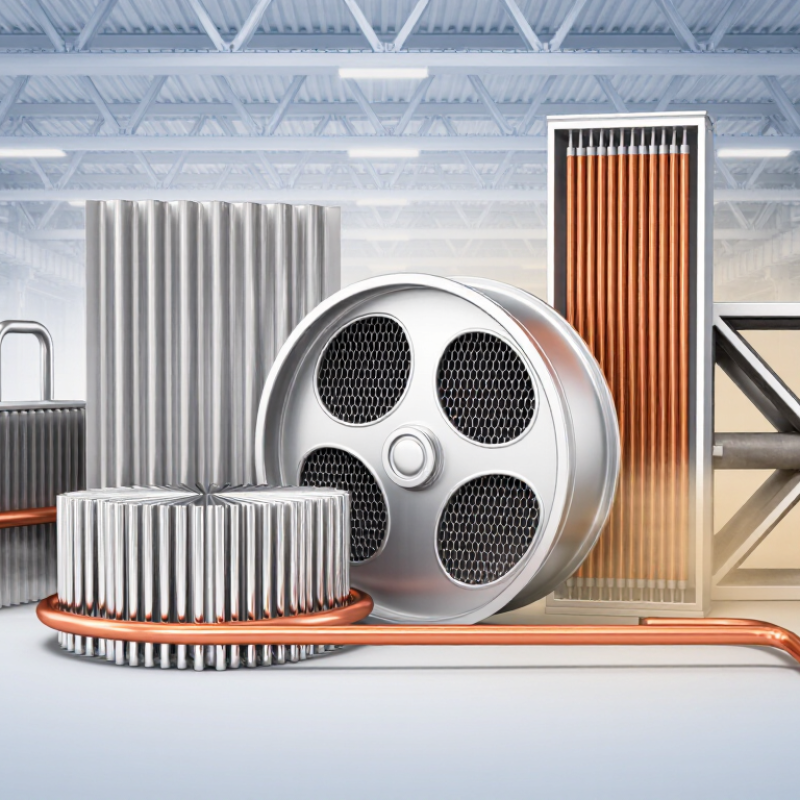
Air heat exchangers transfer heat between air streams without mixing them. They remove unwanted heat, recover energy, or protect temperature-sensitive equipment. Unlike water-cooled units, they use air as the cooling or heating medium. Their performance depends on airflow, surface area, temperature difference, and local climate.
A finned-tube exchanger passes hot fluid through metal tubes while air moves across extended fins. The fins enlarge the contact area and improve heat transfer. Plate-fin designs guide separate air streams through narrow passages, supporting compact installations. Air-to-air recovery units transfer heat between exhaust and incoming air. Dry coolers reject process heat directly to outdoor air, often using fans and coils.
Selection requires more than comparing catalog capacity. Measure entering temperatures, humidity, altitude, dust levels, and available maintenance space. Fan power can become significant in hot climates or restricted installations. Oversized fins may collect debris, while narrow passages can increase pressure loss. A first estimate can be wrong. Real systems are rarely perfect.
Experienced buyers should request tested performance data, materials, airflow details, noise information, and cleaning access. Corrosion resistance also matters near coastal or chemically active environments. During commissioning, compare actual airflow and outlet temperatures with the design values. Small differences may reveal fouling, poor duct alignment, or incorrect sensor placement. Good documentation makes later troubleshooting faster.
Air heat exchangers transfer thermal energy between air and another air stream or fluid without directly mixing the two media. The comparison below summarizes commonly used designs and typical engineering characteristics for buyer evaluation.
| Air Heat Exchanger Type | Operating Principle | Typical Heat-Transfer Media | Typical Sensible Effectiveness or Thermal Performance | Typical Air-Side Pressure Drop | Common Temperature Range | Best-Fit Applications | Main Advantages | Important Limitations |
|---|---|---|---|---|---|---|---|---|
| Fixed-Plate Air-to-Air Heat Exchanger | Two separate air streams flow through alternating channels separated by thin plates. Heat passes through the plates while the streams remain isolated. | Supply air and exhaust air | Approximately 50–80% sensible effectiveness, depending on airflow balance, size, and channel design | Approximately 100–350 Pa per air path | Usually about −30°C to 80°C, subject to material and seal selection | Building ventilation, energy-recovery ventilation, clean-air systems, and industrial air exchange | No moving parts; low maintenance; no cross-contamination when properly sealed; compact construction | Cannot normally transfer moisture unless a permeable membrane is used; frost formation may require defrost or bypass control |
| Rotary Heat Recovery Wheel | A slowly rotating matrix alternately contacts the warm and cold air streams, storing and releasing heat as it rotates. | Supply air and exhaust air; sensible or total energy recovery with suitable matrix coatings | Approximately 65–85% sensible effectiveness; latent recovery depends on the matrix and coating | Approximately 150–400 Pa per air path | Commonly about −40°C to 60°C, depending on seal, rotor, and coating materials | Large commercial buildings, hospitals, airports, factories, and high-outdoor-air ventilation systems | High recovery efficiency; can recover sensible and latent energy; suitable for large airflow volumes | Contains moving parts; requires motor, seals, cleaning, and control; a small amount of carryover or leakage can occur |
| Heat Pipe Heat Exchanger | Sealed heat pipes use an internal working fluid that evaporates in the warm section and condenses in the cool section, transferring heat without a mechanical pump. | Two air streams separated by heat-pipe rows | Approximately 45–70% sensible effectiveness in typical air-handling applications | Approximately 100–300 Pa per air path | Often about −40°C to 80°C, depending on working fluid and casing materials | Ventilation heat recovery, data centers, humidity-control systems, and applications requiring separated air paths | No external power for heat transport; no cross-contamination between air streams; limited maintenance | Primarily sensible heat transfer; performance depends on orientation, airflow arrangement, and heat-pipe design |
| Finned-Tube Air-to-Liquid Coil | Air flows across extended metal fins attached to tubes carrying water, glycol solution, refrigerant, or another liquid. | Air-to-water, air-to-glycol, air-to-refrigerant, or air-to-thermal-oil | Performance is normally specified by heating or cooling capacity rather than a single effectiveness value; commonly selected using coil face velocity and design load | Approximately 50–250 Pa on the air side | Typically about −40°C to 150°C, depending on tube, fin, fluid, and seal materials | Air-conditioning units, process-air heating, cooling coils, heat pumps, and refrigeration systems | Widely available design formats; scalable capacity; suitable for heating, cooling, and dehumidification | Requires a liquid or refrigerant circuit; fin fouling reduces performance; condensate management may be necessary for cooling duty |
| Plate-Fin Air-to-Air Exchanger | Layered plates and fins create separate flow passages for two air streams, increasing surface area and turbulence for heat transfer. | Two air streams or air and another gas | Approximately 50–80% sensible effectiveness, depending on fin geometry and flow arrangement | Approximately 150–600 Pa per flow path | Often about −50°C to 200°C, depending on alloy, brazing, and sealing method | Aerospace systems, gas processing, industrial gas cooling, and compact high-performance equipment | High surface-area-to-volume ratio; compact and lightweight; suitable for demanding temperature duties | More sensitive to fouling and blockage; cleaning can be difficult; manufacturing and repair may be more specialized |
| Shell-and-Tube Air Cooler | Process fluid travels inside tubes while ambient or forced air flows over the external tube surfaces, usually with extended fins. | Process liquid or gas-to-air | Capacity is determined by overall heat-transfer coefficient, surface area, airflow, and temperature approach rather than a fixed effectiveness value | Approximately 100–500 Pa on the air side, excluding fan system losses | Commonly about −40°C to 250°C, with higher temperatures possible using specialized materials | Petrochemical processing, power generation, industrial cooling, and outdoor process equipment | Robust construction; suitable for large process duties; no cooling-water circuit required on the air side | Large footprint for high capacity; fan power and ambient conditions strongly affect performance; noise control may be required |
| Crossflow Air-to-Air Exchanger | Two air streams move approximately perpendicular to each other through separate passages divided by heat-transfer surfaces. | Supply air and exhaust air | Approximately 40–70% sensible effectiveness in typical non-condensing designs | Approximately 100–350 Pa per air path | Usually about −30°C to 80°C, depending on construction materials | Compact ventilation units, residential systems, small commercial buildings, and equipment enclosures | Simple airflow arrangement; compact height; easy integration into packaged ventilation equipment | Generally less effective than counterflow designs at the same size; frost and condensate control may be needed |
| Counterflow Air-to-Air Exchanger | Two air streams travel in opposite directions through adjacent channels, maintaining a favorable temperature difference across most of the exchanger length. | Supply air and exhaust air | Approximately 70–90% sensible effectiveness in well-designed systems | Approximately 150–500 Pa per air path | Commonly about −40°C to 80°C, subject to seals and construction materials | High-efficiency ventilation, cold-climate buildings, laboratories, and energy-recovery air-handling units | High thermal effectiveness; good temperature approach; strong energy-saving potential | Longer flow path can increase pressure drop; frost protection and condensate drainage may be required in cold or humid conditions |
| Evaporative Air Cooler | Air is cooled by water evaporation, either directly into the airstream or indirectly through a heat-transfer surface that keeps the air streams separated. | Air and water; indirect systems use separate air paths | Direct systems can achieve approximately 70–90% of the wet-bulb temperature difference; indirect performance varies by design | Approximately 50–250 Pa, excluding external duct and fan losses | Most effective in dry climates; operating limits depend on water quality, freezing risk, and equipment materials | Industrial ventilation, agricultural buildings, warehouses, data-center pre-cooling, and dry-climate comfort cooling | Low electrical energy use compared with compressor cooling; effective during hot and dry weather | Consumes water; adds humidity in direct systems; performance decreases at high ambient humidity; water treatment and hygiene control are important |